


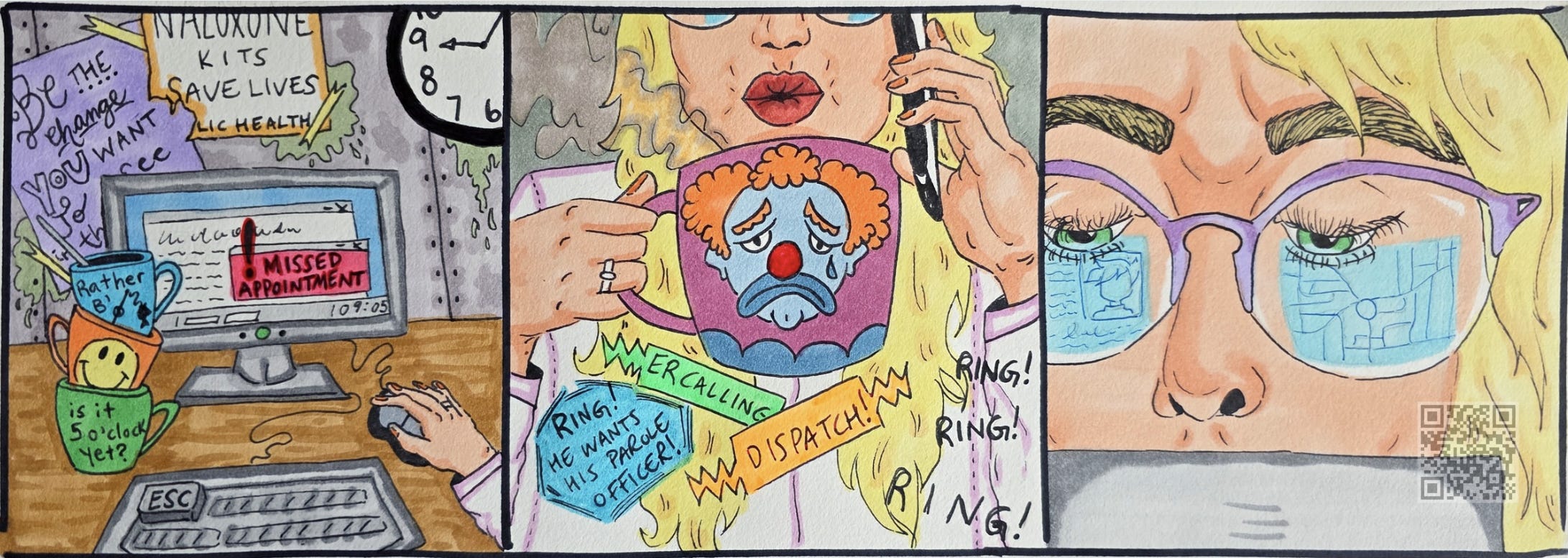
Officer Athena drains her third coffee in a windowless “community” corrections office. Client #60606 misses check-in again. ER calls: Bill wants to check in by phone. She hangs up, calls dispatch. Twenty minutes later—General Hospital. Cancel, redirect. An hour later—Good Samaritan. Same story.
Athena scrolls his file: “Lacks judgment.” GPS alert: “Erratic movement.” Translation: touring hospitals like a pub crawl.
Outside, cruisers chase ghosts. Inside, Athena hits redial like a metronome.
Bill’s collecting healthcare, dodging jail, and still technically compliant. She’s the one trapped in a cell.
Who’s really insane here?
Hidden in Plain Sight: Dispatches to Nowhere
Frontline Peer tips its hat this week to Natalie McLeod, whose illustration nails the visual syntax of public secrecy1—and drives home the punchline: clients and practitioners alike are trapped in systems that claim to manage risk but mostly manufacture chaos. Paradoxes abound this is a story about systems, not scapegoats.
Probation, parole, and their community-corrections cousins (bail, diversion, supervision, etc.) sit awkwardly between coercion and care2. Staff get reduced to ‘street level bureaucrats’3—moonlighting as ‘third-party police’4—stuck in endless social triage5. Meanwhile, risk logic bears down hardest on those already carrying multiple disadvantages6.
The comic captures a liminal space—”hidden in plain sight”7— and begs the question: is it a feature or a bug? The same clients who shuffle through the justice system rotate through ER waiting rooms8. Hospitals triage people in, prisons triage people out. Sometimes, prison is even sought as a temporary refuge from the streets9. Crazymaking, no?
And inside the system? Not much brighter. First responders are burning out at alarming rates and in need of recognition and care10. Meanwhile, McJustice is served like a drive-through11,12—or worse: a treadmill that never stops running13.
Here’s to a front-row seat in this tragicomedy.

PS: Throw your thoughts into the mix—or nudge a peer to share theirs! Also, if you know a creative illustrator—we're hiring.
What’s the most absurd thing you’ve seen in your workplace? Share your story—confession box style.
We promise not to say who told us.
Paperwork That Holds Up in Court
Taussig, M. Defacement: Public Secrecy and the Labor of the Negative. Stanford University Press, 1999.
Phelps, M. S., & Ruhland, E. L. “Governing Marginality: Coercion and Care in Probation.” Social Problems 69, 799–816 (2022).
Lipsky, M. Street-Level Bureaucracy. Russell Sage Foundation, 2010.
Myers, N. M. “Jailers in the Community: Responsibilizing Private Citizens as Third-Party Police.” Canadian Journal of Criminology and Criminal Justice 61, 66–85 (2019). https://doi.org/10.3138/cjccj.2017-0040
Quirouette, M. “Social Triage and Exclusions in Community Services for the Criminalized.” Social Problems, spad035 (2023).
Quirouette, M. “Community Practitioners in Criminal Courts: Risk Logics and Multiply-Disadvantaged Individuals.” Theoretical Criminology 22, 582–602 (2017). https://doi.org/10.1177/1362480617707951
Shah, R. “Hidden in Plain Sight: Architectures of Community Corrections as Public Secret.” Probation Journal 67, 137–159 (2020). https://doi.org/10.1177/0264550520911963
Milgram, A., Brenner, J., Wiest, D., Bersch, V., & Truchil, A. Integrated Health Care and Criminal Justice Data: Lessons from Camden, New Jersey. (2018).
Bucerius, S., Haggerty, K. D., & Dunford, D. T. “Prison as Temporary Refuge: Amplifying the Voices of Women Detained in Prison.” The British Journal of Criminology 61, 519–537 (2021). https://doi.org/10.1093/bjc/azaa073
Government of Canada. State of Public Health in Canada. Public Health Agency of Canada, Ottawa, 2020.
Crook, R., & Wood, D. “‘The Customer Is Always Right’? Consumerism and the Probation Service.” European Journal of Probation 6, 57–66 (2014). https://doi.org/10.1177/2066220314523229
Robinson, G. “Delivering McJustice? The Probation Factory at the Magistrates’ Court.” Criminology & Criminal Justice 19, 605–621 (2018). https://doi.org/10.1177/1748895818786997
Cracknell, M. “Running on the Treadmill: Practitioner Experiences of Mass Supervision.” European Journal of Probation 14, 109–127 (2022). https://doi.org/10.1177/20662203221104925
