

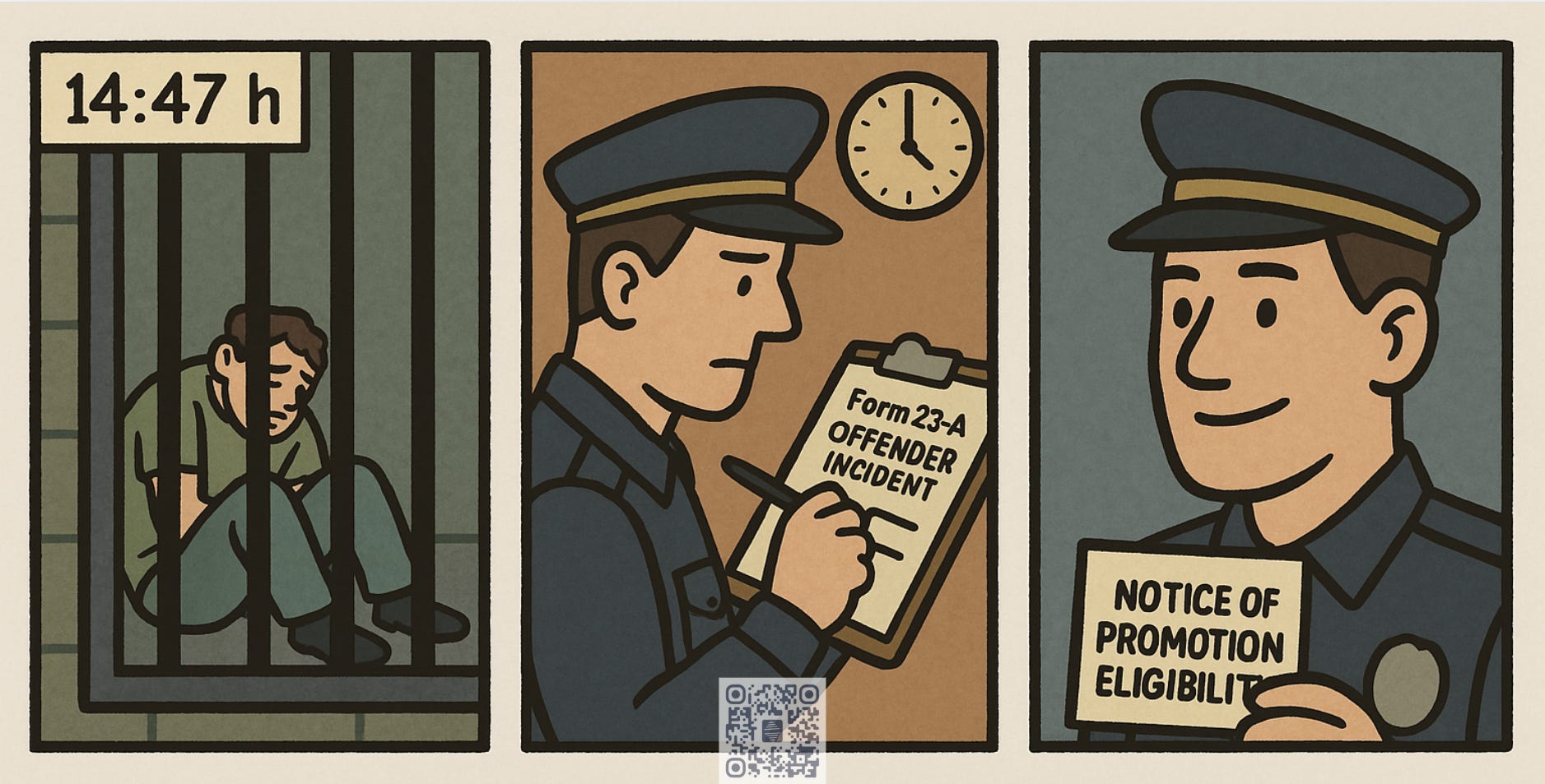
Officer Sully finds an inmate passed out in his cell at 14:47h. Classic diabetic episode—needs immediate medical attention. But Sully knows the routine: first secure the scene. Then, get on to paperwork. While the inmate’s breathing gets shallow, Sully starts the 'Offender Incident Report'. Next, form 23-B: Medical Emergency Addendum. Then, three Witness Statements from the inmates who swear they saw nothing—each now required to attest they indeed saw nothing. Seventy-three minutes and four signatures later, Sully finally calls medical. The inmate survives. Sully logs two hours of overtime and documents everything by the book. Policy says: “life-threatening incidents require immediate action.” Turns out, the immediate action was paperwork. Promotion pending.
Safety, Sanity, and the Paperwork in Between
This week, Frontline Peer welcomes you to a fresh hot-take.
Think narrative-exposé meets infotainment.
Bi-weekly while you sip that Friday morning corporate coffee—we’re serving safety ironies steeped in Reason1, meant to provoke thought, spark debate, and give us all a laugh.
Because if you ain’t laughing, you’re crying—or worse—filling out a Form 27-B.
In this canteen special: the so-called “iron cage” of rationality, as Max Weber once put it—and as many penal practitioners might mutter under their breath. Folks sign up for prison work with visions of helping people, only to find themselves trapped in a system obsessed with efficiency metrics, risk formulas, and control policies that treat “people” as policy items.
The irony for human-service fields like corrections is sharp: most start out as “people people.”2 But the toll of administrative harms3—the endless forms, audits, and justifications—can make even the most dedicated public safety personnel unwell4.
Police, paramedics, and countless practitioners get disillusioned by paperwork creep. As one cop was quoted saying in a recent piece: “It’s frustrating… I didn’t join to sit behind a desk.”5 She speaks for thousands in law enforcement, and beyond.
Here’s the paradox: people join for the casework and stay for the people. They leave when the work turns into proving they’re working, one PDF at a time.
Stay tuned till next time where we touch on the insanity of forensic care!

Your turn
What’s the most ‘by-the-book’ absurdity you’ve ever seen on the job?
Comment below to spark debate—or, if it’s too real for the comment section, send it to Frontline Peer and let us turn your workplace irony into the next feature.
Classified
If this week tickled your fancy, here is exclusive access to “The Ironies of Innovation: Lessons in Human Factors for Corrections” by Frontline Peer’s founder, Mike Taylor.
Perfect while sipping morning joe—preferably, while doing paperwork you’ll later have to document you did. Its our gift, from one peer to another.
Reason and others describe safety in terms of ‘irony’ and ‘paradox’ see, for example:
Reason, J. (2000). Safety paradoxes and safety culture. Injury Control and Safety Promotion, 7(1), 3-14. https://doi.org/10.1076/1566-0974(200003)7:1;1-V;FT003
Hollnagel, E., & Dekker, S. W. A. (2024). The ironies of ‘human factors’. Theoretical Issues in Ergonomics Science, 1-11. https://doi.org/10.1080/1463922X.2024.2443976
Worrall, A., & Mawby, R. C. (2014). Probation worker cultures and relationships with offenders. Probation Journal, 61(4), 346-357. https://doi.org/10.1177/0264550514548251
McGann, M., & Ball, S. (2024). Beyond administrative burden: Activation and administrative harm. Australian Journal of Social Issues. https://doi.org/10.1002/ajs4.371
Carleton, R. N., Afifi, T. O., Taillieu, T., Turner, S., Mason, J. E., Ricciardelli, R., McCreary, D. R., Vaughan, A. D., Anderson, G. S., Krakauer, R. L., Donnelly, E. A., Camp, R. D., 2nd, Groll, D., Cramm, H. A., MacPhee, R. S., & Griffiths, C. T. (2020). Assessing the Relative Impact of Diverse Stressors among Public Safety Personnel. Int J Environ Res Public Health, 17(4). https://doi.org/10.3390/ijerph17041234
Ricciardelli, R., Carbonell, M., Ferguson, L., & Huey, L. (2023). “It's frustrating … I didn’t join to sit behind a desk”: Police paperwork as a source of organizational stress. International Journal of Police Science & Management, 25(4), 516-528. https://doi.org/10.1177/14613557231188578