


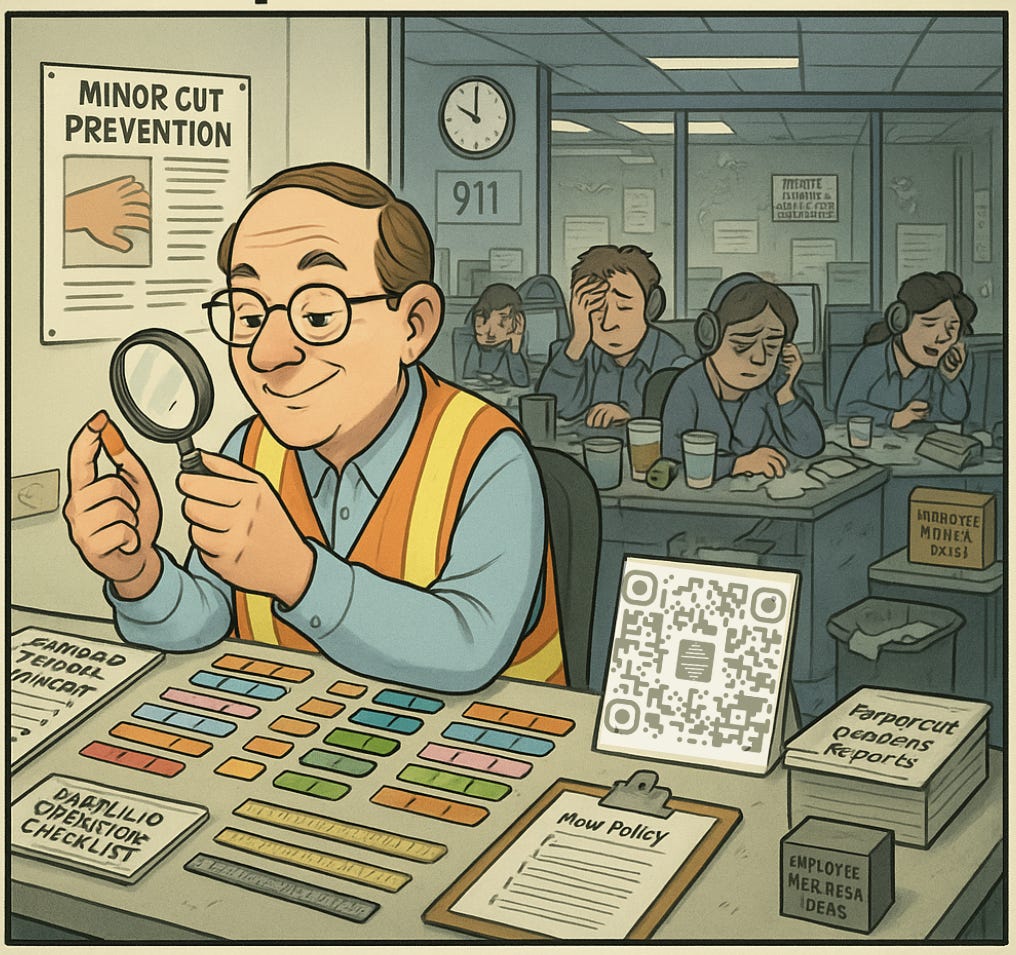
To Cut Through The Noise: This Week in 60-Seconds
Systems are burning out safety-critical workers 1.
Stress is mostly from bureaucracy, not clients 2.
Frontline Peer exists to mobilize frontline knowledge 3.
Echo Program is live, learn or have your say. Support our mission by contributing to the conversation or sharing with someone who cares:
Frontline Peer began with a simple idea.
Working in the justice system, I saw how systems were set up to fail. Caseloads cycled endlessly through probation and parole, and only “failures” ever reappeared in my windowless office. Over time, confirmation bias hardened correctional cultures into cynicism 4,5.
Here’s the irony: we measured everything except what mattered. Car garages hand out feedback surveys after an oil change, yet in prison work, no administrative survey ever asked clients, post release—how did we do punishing you?
Cynical? Maybe. But what could we learn if we took that approach—if we dialogued with wrongdoers about harm, and it's potential for capacity building? 6
Fast forward to today’s corporate environments. Liability management, blame, and reputational risk dominate. Accountability trickles down as finger-pointing rather than justice 7. I didn’t have the words for it then. But after some PhD reprieve, I see it clearly now: public safety personnel are burning out, with stress injury claims and time off work as the social proof 1.
Why Frontline Peer
I founded Frontline Peer as a space to develop insight from the ground up, drawing on “tacit knowledge” 3—the kind bureaucracies can’t quite grasp.
Correctional workplaces are a prime example: psychosocial hazards are baked into the environment 8. Literature shows probation and parole officers—like I once was—experience most of their stress not from clients, but from “administrative harms” that choke the work people find meaningful 9. Colleagues echo the same finding: three-quarters of stressors come not from casework, but from often the nonsensical bureaucracy itself 2.
That recognition showed me my own need for wellbeing. And it’s why Frontline Peer exists: to preserve, translate, and mobilize frontline knowledge into tools for wellness, resilience, and operational insight.
What We’re Co-Creating Together
If you’re an early adopter—thank you for subscribing. Here's to what's coming:
Peer-to-Peer Networks Are the Future.
Think blockchain, torrents file-sharing, decentralization among the masses. The digital age won’t conform to bureaucratic convention. Frontline Peer is innovating a channel for learning and broadcasting insight from the ground up. It's no longer about official messaging by employers or unions, but clusters of informed people collaborating on what matters. Stories are meaningful—check out mine on how I transformed my voice into scholarship and won a national SSHRC Storytellers Award.
Wellness Is a Common Goal.
For staff, for clientele, for the public: folks have a common interest in well-being. Let’s dismantle the checkbox version of “peer support” as you’ve heard it before. Elsewhere I’ve argued for “collegial de-briefing” 10. Frontline Peer is building upon that idea by imagining digital democracy: education as the foundation, voice as currency. Share your story of misrecognition, insecurity, or unsafe encounters with administrative harms and submit, anonymously, through the Echo Program, here.
User-Centered Design in Principle.
This isn’t whistleblowing, it’s narrative-driven reporting from the bottom up. No insight is too small. Collectively, they reveal patterns to design more responsive workplaces and make institutions humane for the 21st century.
How To Get Involved
Subscribe. If you believe in this mission, spread the word.
Share Your Story. Contribute anonymously through the Echo Program; stay tuned for what's in store
Shape What Comes Next. Submissions guide future tools, research, and resources, so have your say.
While we continue to grow this community of safety-critical pros, and incubate at Memorial University’s Centre for Social Enterprise, insights may arrive weekly or bi-weekly as resources ramp up.
But know this: we’re here for the long haul, and your involvement now will shape where we go next.
Your voice matters. If you’re subscribing, it’s because you want to be heard.
So—let’s hear what you've got to say.

Micheal P. Taylor, Founder
www.frontlinepeer.com
Notes
1 Edgelow, M. & Fecica, A. Occupational therapy treatment of public safety personnel with work-related psychological injuries: analyzing Ontario worker’s compensation data from 2017–2021. Frontiers in Psychiatry 15 (2025). https://doi.org/10.3389/fpsyt.2024.1377157
2 Norman, M. & Ricciardelli, R. Operational and organisational stressors in community correctional work: Insights from probation and parole officers in Ontario, Canada. Probat Journal 69, 86-106 (2022). https://doi.org/10.1177/0264550520984253
3 Nonaka, I. & Von Krogh, G. Perspective—Tacit knowledge and knowledge conversion: Controversy and advancement in organizational knowledge creation theory. Organization science 20, 635-652 (2009).
4 Regoli, R., Poole, E. & Schrink, J. Occupational Socialization and Career Development: A Look at Cynicism Among Correctional Institution Workers. Human Organization 38, 183-187 (1979). https://doi.org/10.17730/humo.38.2.x061g4w710v2022h
5 Schultz, W. Unspoken commandments: Contemporary correctional officer work cultures and their influence on prison conditions Doctor of Philosophy thesis, University of Alberta, (2023).
6 Christie, N. Conflicts as property. British Journal of Criminology 17, 1-15 (1977). https://doi.org/10.1093/oxfordjournals.bjc.a046783
7 Dekker, S. Just Culture: Restoring Trust and Accountability in Your Organization (CRC Press, Boca Raton, FL, 2017).
8 Montoya-Barthelemy, A. et al. Occupational and Environmental Hazards of Correctional Settings: A Scoping Literature Review From ACOEM's Presidential Task Force on Correctional Institutions. J Occup Environ Med 64, e172-e182 (2022). https://doi.org/10.1097/JOM.0000000000002440
9 McGann, M. & Ball, S. Beyond administrative burden: Activation and administrative harm. Australian Journal of Social Issues (2024). https://doi.org/10.1002/ajs4.371
10 Taylor, M. P., Ricciardelli, R. & Spencer, D. C. Parole work in Canada: The realities of supervising “sex offenders”. Probation Journal 72, 46-67 (2024). https://doi.org/10.1177/02645505231223173