


I want to tell you something that took me years of academic training, a psychological injury, and a lot of uncomfortable honesty to be able to say clearly.
The reason you don’t speak up at work isn’t because you’re weak. It isn’t because you lack resilience, or emotional intelligence, or the right coping strategies. It’s because your organization taught you, through consequences, culture, and a thousand small signals, that speaking up costs more than staying quiet.
That silence isn’t a personal failing. It’s a rational response to a broken system. And it’s killing people.
I know because it nearly broke me.
The injury nobody talks about
I spent more than half a decade as a probation and parole officer. I was good at the work. I cared about it in the way that people who end up in public service tend to care — not because the pay was exceptional or the hours were forgiving, but because it felt like it mattered. Because the people on my caseload were human beings navigating some of the hardest circumstances imaginable, and I believed that how I showed up for them made a difference.
What I wasn’t prepared for was what would happen when I got hurt.
The operational exposure — the vicarious trauma, the weight of other people’s stories accumulating over years — that was hard. I won’t minimize it. But I had frameworks for that. What I didn’t have a framework for was the institutional response when I raised my hand and said: I’m not okay.
The message, delivered not with cruelty but with the particular indifference of an organization that valued process and procedure, rather than people, was clear: get on with it.
There was no malice in the people who delivered that message. I want to be precise about that, because this isn’t a story about villains.
The supervisors closest to me — the ones I worked alongside daily — I hold them in the highest regard. The failure wasn’t personal. It was structural. It was the predictable outcome of a governance architecture designed a century ago that was never built to honor the humanity of the people operating inside it today.
But here’s what I’ve come to understand through a few years of scholarship and an embarrassing amount of reflection. The organizational injury is about the experience of being unseen, unheard, and misrecognized by the institution you serve that compounds an already festering wound.
Sometimes it surpasses it.
You can survive operational trauma. What’s harder to survive is the moment the employer looks straight through you and reaches for the policy manual.
That’s the double injury. And few are speaking directly to the heart of it.
What the research actually says
I’m a PhD candidate at Memorial University of Newfoundland, where I’ve had the privilege of working under the supervision of Professor Rosemary Ricciardelli — one of Canada’s foremost researchers on PSP mental health. The literature confirms what my own experience reflects. Reticence among public safety personnel is not a cultural defect or a personality trait.
It is institutionally re-produced. The silence you carry isn’t yours. It was handed down to you.
Organizations are extraordinarily efficient at suppressing tacit knowledge — the embodied, experiential understanding of what the work actually does to a person over time. That knowledge doesn’t fit neatly into a performance review or an incident report. It can’t be captured in the wellness survey that HR sends out every so often and files away before it is acted upon. And because it can’t be easily codified, it doesn’t travel up the chain.
It stays where you are, unspoken, and accumulating.
The gap between what people on the ground carry and what administrators believe is happening is not a communication problem in the ordinary sense. It’s a structural one. And the wider that gap grows, the more injurious the environment becomes — for the people working in it, and eventually for the public they’re meant to serve.
This is what I mean when I say organizational communication failures are a primary and modifiable driver of psychological injury in PSP. Not the only driver. Not more important than what you see on the job. But modifiable — which means addressable. Which means we have no excuse for ignoring it.
Why I built Frontline Peer™ — and what it actually is
I didn’t set out to build a social venture. I just wanted to make sense of what happened to me. Academic work gave me the tools for that. But somewhere in the process of building frameworks and reviewing literature and conducting my qualitative research, I kept running into the same wall. The knowledge existed, the research was accumulating, and it didn’t seem to mobilize in a way that meant it was meaningfully getting back to the people who needed it most.
The people who could most benefit from understanding that their reticence is institutionally produced — that they aren’t broken, that what they’re experiencing is documented and named and shared by thousands of colleagues across the country — those people aren’t reading academic journals. They’re working nights. They’re managing injuries nobody can see.
They’re biting their tongues.
Frontline Peer™ is my attempt to close that distance.
It’s an early-stage social venture — I’ll be honest about that — pre-revenue, still learning, still calibrating. It’s incubated through Memorial University’s Centre for Social Enterprise and developed through a Mitacs Accelerate partnership. The academic oversight is real, the governance framework is built on PIPEDA-compliant consent architecture, and the conflict of interest declared for full transparency.
Transparency isn’t a footnote in this operation. It’s baked in to the social mission.
Here’s what it is in plain language: it’s a communication feedback loop. A mechanism for PSP to share their experiences in a way that their accounts actually count — in terms that administrators can understand, in forms that can inform the organizations that are currently operating blind.
The people who share their stories aren’t the product. They’re the point.

What I’m asking you to do
I’m not asking for much. I’m asking for what you already carry.
If you’re the kind of person I’m building this for — someone with direct operational experience who also thinks in systems, who has felt the gap between what the policy says and what the job actually does to a body over time, who has something to say and nowhere safe to say it — I want to hear from you.
There are three ways to engage, at whatever level feels right.
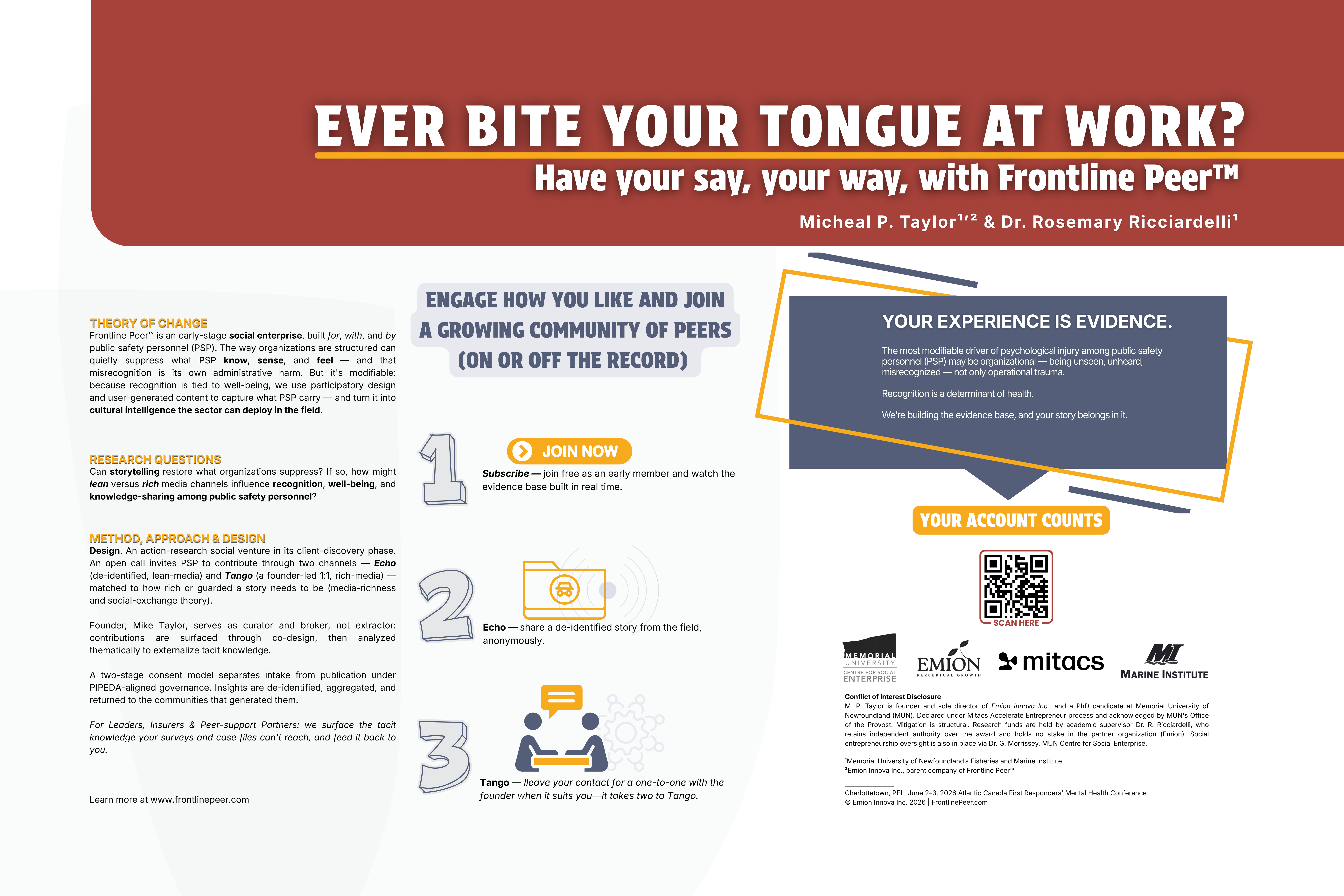
Subscribe to this blog/newsletter dispatch for Free. Published when there’s something worth saying. This is where the ideas develop in public, where the evidence base gets built in real time, where I write honestly about what I’m learning and where I’ve got it wrong.
Submit an Echo — an anonymous, de-identified account from the field. No name. No identifying details. Your story gets anonymized, aggregated, and returned to the communities that generated it. Not filed away. Not sold. Returned. That’s the commitment.
Book a confidential peer call with me directly, if you’d rather talk than type. One-to-one. On your schedule. No agenda beyond understanding what you’re carrying and whether there’s a way I can help. frontlinepeer.com/contact/confidential-peer-call
The thing I keep coming back to
There’s a line on the poster we presented in Charlottetown that I want to leave you with, because I think it’s the truest thing I’ve written about this work.
Your experience is evidence.
Not anecdote. Not complaint. Not a morale problem for HR to manage.
Evidence — about what the system is doing to the people inside it that has real implications for how organizations could be re-designed.
Right now, the sector is making consequential decisions about your mental health, your working conditions, and your future — without that evidence. Without your account. Without a reliable mechanism for tacit knowledge to reach the people who need it.
That’s what I’m trying to change with you, not for you.
The door is open and I’m listening.

Micheal P. Taylor, Founder
Frontline Peer™