

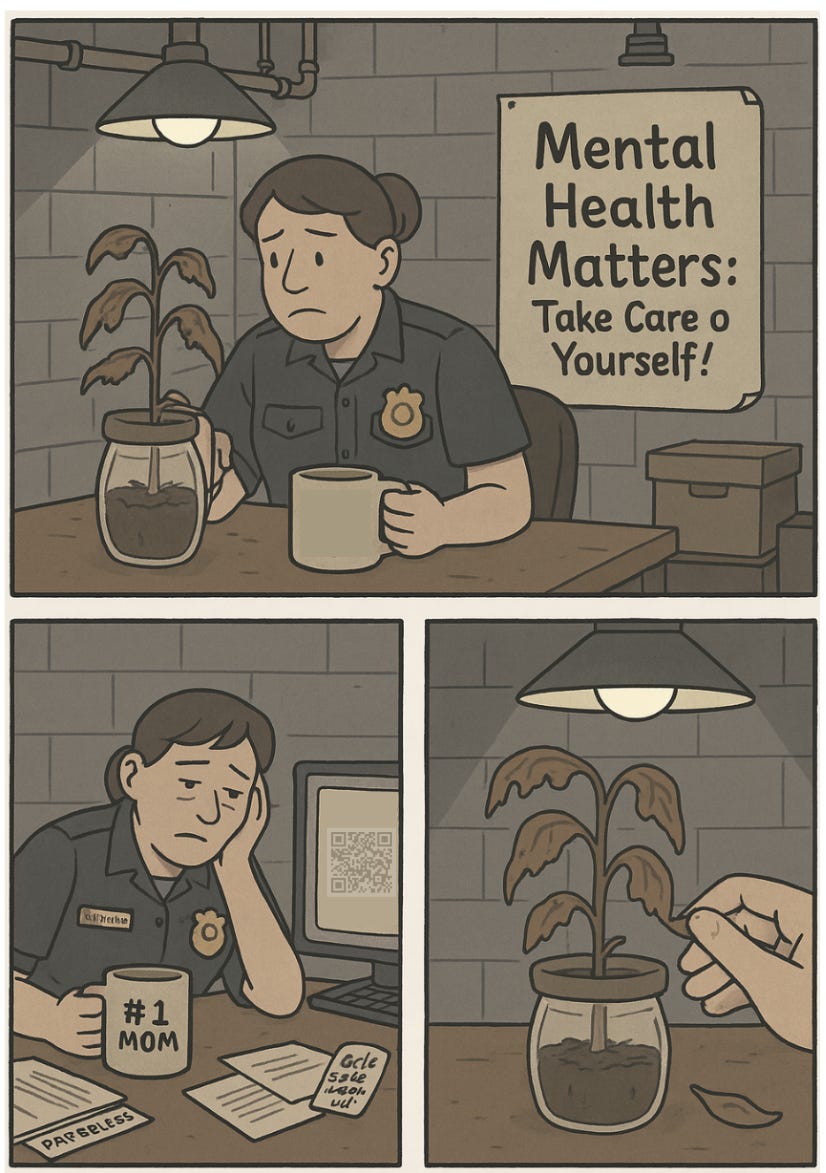
Officer Sally sits in a windowless office where she’s mandated to be well. The marching orders are clear: survive your caseload, clear the backlog, and carry the burden of wellness too. She pokes at her withering evergreen: if a plant can’t thrive here, what chance does wellness have?
When Did Being Well Become Just Another Checkmark?
We’re still hunting for an illustrator who can capture absurdity—because frontline experience deserves more than AI filler. So, if you can draw, step up here. Its part of our mission for responsive recognition. Recognition matters, and that’s exactly what’s at stake this week: the moral injury that happens when workplace behavior collides with personal values1. It’s not “burnout.” It’s a fracture in purposeful leadership2. If there’s one thing we all have in common, it’s the desire to be well—and recognition is key to that shared human condition3.
Here’s the irony: public safety workers sign up to keep everyone else safe, and in return, they inherit ill-being as a real occupational hazard4,5. The data keep stacking—disproportionate stress injuries and mental health disorders among the very people sworn to prevent harm6. Their environments don’t just expose them to risk; they sometimes manufacture hazards wholesale7. It’s cultural—shaped by values, behaviors, and distorted priorities8.
The field itself can’t even escape the paradox, since “safety” is more often described by its absence than presence, the tendency is tally up failures rather than measure success9. In brief, blame gets situated on people rather than the real work of interrogating systems10.
So, at Frontline Peer we’ll keep punching-up, siding with those who need reprieve—especially when taking time-off gets framed as ‘gaming the system’11.
Maybe the question isn’t whether workers are resilient, but whether systems are designed to meet people’s needs in the first place12.
If survival counts as wellness, what does thriving even look like?
Here’s to helping you thrive through another week,

Key Takeaway
When organizations outsource well-being to individuals, they shift responsibility away from leadership. That’s not wellness—it’s liability management.
PS: Enjoy what you’re reading? Share your thoughts and get recognized among peers—or send us a story about the most ironic thing in your workplace. We’re interested in systems and scenarios, not your private affairs.
Your story isn’t just a vent—it’s evidence that can reshape how safety is imagined and done.
Notes
Dean, W., Talbot, S. & Dean, A. (2019). Reframing clinician distress: moral injury not burnout. Federal Practitioner, 36, 400.
Emler, N. & Cook, T. (2001). In Personality psychology in the workplace (Ch. 11, pp. 277–298).
Lamont, M. (2023). Seeing Others: How Recognition Works—and How It Can Heal a Divided World. One Signal Publishers.
Carleton, R. N. et al. (2018). Mental disorder symptoms among public safety personnel in Canada. Canadian Journal of Psychiatry, 63, 54–64. https://doi.org/10.1177/0706743717723825
Ricciardelli, R., Czarnuch, S., Carleton, R. N., Gacek, J. & Shewmake, J. (2020). Canadian public safety personnel and occupational stressors: How PSP interpret stressors on duty. International Journal of Environmental Research and Public Health, 17. https://doi.org/10.3390/ijerph17134736
Ricciardelli, R., MacDermid, J. C. & Ferguson, L. (2024). In Occupational Stress Injuries (pp. 1–12).
Taylor, M. P., Ricciardelli, R. & Shively, R. (2024). “Making a difference”: Interpreting responsivity ambience for parole work. Heliyon, 10, e39617. https://doi.org/10.1016/j.heliyon.2024.e39617
Taylor, M. P., Ricciardelli, R., Maier, K. & Norman, M. (2025). ‘A prioritizing game’: Coachability in Canadian parole workplace culture. Criminal Justice Studies, 1–21. https://doi.org/10.1080/1478601x.2025.2470165
Reason, J. (2000). Safety paradoxes and safety culture. Injury Control and Safety Promotion, 7, 3–14. https://doi.org/10.1076/1566-0974(200003)7:1;1-V;FT003
Dekker, S. (2023). Stop Blaming: Create a Restorative Just Culture. Self-Published.
Ricciardelli, R., Carleton, R. N., Mooney, T. & Cramm, H. (2020). “Playing the system”: Structural factors potentiating mental health stigma, challenging awareness, and creating barriers to care for Canadian public safety personnel. Health (London), 24, 259–278. https://doi.org/10.1177/1363459318800167
Taylor, M. P. & Ricciardelli, R. (2025). “We’re not worth it”: Canadian parole officers’ self-worth contingencies—a valuation for job fitness? Social Sciences & Humanities Open, 11, 101532. https://doi.org/10.1016/j.ssaho.2025.101532